
Beyond Safety Upgrades: Designing Your Home for Aging-in-Place
If you have found yourself thinking, “We want to stay in this home long term,” you are not alone. Many homeowners in Corvallis, Albany, and across the mid-Willamette Valley share the same goal.
You may love your neighborhood in Timberhill or along Kings Boulevard in Corvallis, or in established Albany neighborhoods like North Albany, Spring Hill, or older areas near Timber Linn Park. You are close to friends, familiar routines, healthcare, and the places that feel like home. Moving is not what you want. What you want is for your house to continue supporting you comfortably for years to come.
What is Aging-in-Place?
McLennan Contracting said it well, “Aging in place means having the ability to remain in your home safely, independently, and comfortably. It sometimes requires remodeling or modifying the home so it remains accessible and functional as needs change over time. It’s proactive planning for today—and tomorrow.”
When the conversation about aging in place begins, it often starts with a short list:
Add grab bars. Replace the tub with a walk-in shower. Improve the lighting.
Those upgrades can certainly help. But if you have lived in your home for 20 or 30 years, you already know the bigger truth. The way your home flows day to day matters just as much as any single fixture.
The real question is not simply, “Is it safe?”
It is, “Will this home continue to feel easy, comfortable, and supportive as our needs change?”
Aging-in-place remodeling is not about creating a clinical space or adding visible safety hardware after the fact. It is about thoughtful planning. It is about circulation, comfort, lighting, and long-term flexibility woven into the design from the beginning.
When you approach it proactively, your home can remain timeless, welcoming, and beautifully aligned with how you want to live for decades to come.
The Real Issue Most Homeowners Don’t See at First

When you start thinking about aging in place, it is completely natural to focus on visible safety features.
You might think:
- We can add grab bars later.
- We will swap the tub for a curbless shower.
- If needed, we can widen a doorway down the road.
Those upgrades feel manageable. They seem like small adjustments you can make when the time comes.
But in many homes across Corvallis and Albany – especially ranch homes from the 1970s and 1980s or split-level layouts- the real challenge is not the hardware. It is the structure and flow of the space itself.
A narrow hallway that has always felt “fine” can quickly become frustrating when mobility changes.
A small primary bathroom that works today may not allow enough clearance for comfortable movement later.
A laundry room tucked into the basement can become a daily obstacle long before anyone considers it a problem.
What we often see is this: safety features are added into spaces that were never designed to support them.
The result?
- Showers that technically meet accessibility guidelines but feel cramped.
- Bathrooms that look pieced together instead of thoughtfully designed.
- Doorways widened after finishes are already in place, creating visual inconsistencies.
- Upgrades that solve one issue but introduce another.
The friction is subtle at first. It shows up in tight turns, dim lighting, reaching overhead, or stepping over small thresholds. Over time, those small points of friction add up and affect how confident and comfortable you feel in your own home.
Aging-in-place remodeling is not just about preventing accidents. It is about reducing daily strain. It is about creating ease.
And ease rarely comes from isolated upgrades. It comes from stepping back and evaluating how your home truly works as a whole.
What Actually Makes a Home Work Long Term
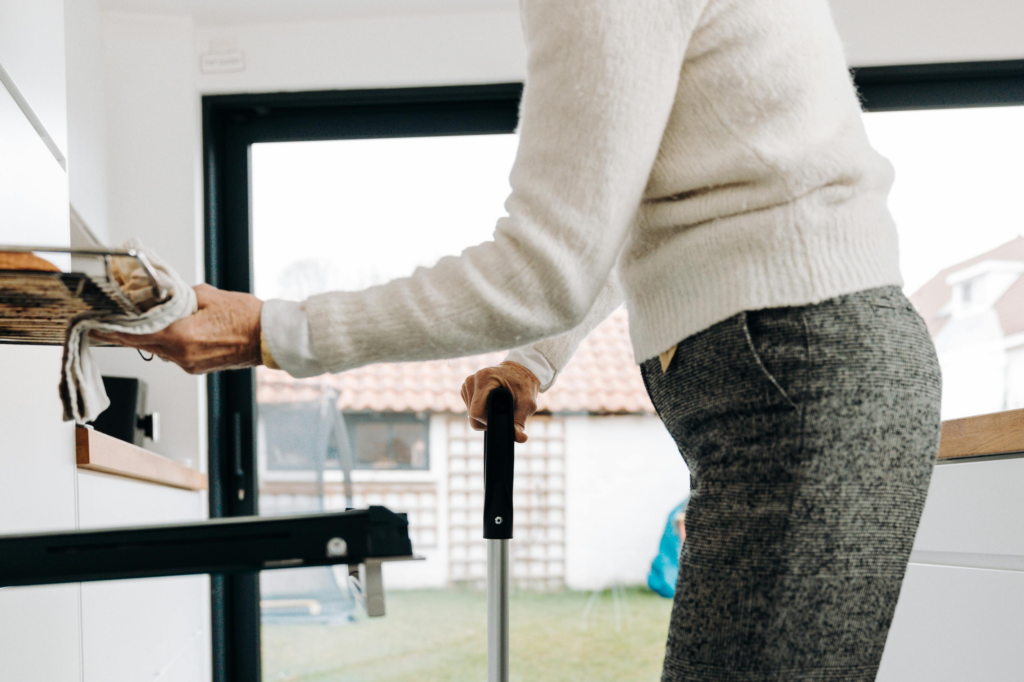
If aging in place is not just about safety features, what makes the difference?
In our experience working with homeowners across the mid-Willamette Valley, it comes down to how your home functions day-to-day. The details matter, but the layout matters more.
Here are the elements that have the biggest impact over time.
Circulation and Maneuverability
Clear pathways are one of the most overlooked components of long-term comfort.
In many pre-1990 homes in Northwest Corvallis or Timberhill, especially, hallways were designed efficiently rather than generously. Bathrooms are compact, without considering future mobility needs.
When we evaluate a home for aging in place, we look at:
- Turning radius in bathrooms and bedrooms
- Clearance around vanities and islands
- Door swings and how they affect movement
- Transitions between rooms
Sometimes this means expanding a bathroom rather than simply replacing fixtures. Other times, it means reworking walls or adjusting adjacent spaces to create better flow.
A Main-Level Living Strategy
One of the biggest turning points for long-term livability is whether daily life can occur on a single level.
If your primary bedroom is upstairs, or your laundry is in the basement, it may not feel urgent today. But many homeowners tell us later they wish they had addressed that sooner. This is especially common in North Albany and established Corvallis neighborhoods, where two-story homes were the norm during peak development years.
A thoughtful plan might include:
- Relocating laundry to the main level
- Converting a den into a future-ready primary suite
- Designing an addition that supports single-level living
Planning this proactively allows those changes to feel intentional rather than reactive.
Bathroom Size and Shower Design
A curbless shower alone does not guarantee comfort.
The size of the bathroom and the shower enclosure matter just as much. Adequate clearance, built-in seating, properly positioned controls, and accessible storage all contribute to ease of use.
Consider these accessible bathroom remodeling ideas from Janacek Remodeling that blend style with function:
- Comfort-Height Toilets & Vanities: These small shifts make a major difference in daily comfort and accessibility.
- Curbless Showers: Sleek, modern, and safer than step-in tubs or stalls. Pair them with linear drains to enhance both function and design.
- Integrated Bench Seating: Great for convenience now and stability later.
- Wall Reinforcements for Grab Bars: Even if you’re not ready to install them, prep the walls now so they’re easy to add later.
- Motion-Activated Lighting: Avoid nighttime stumbles and elevate the spa-like feel.
When planned early, these features can feel seamless and elegant, not clinical or retrofitted.
Layered Lighting
Lighting dramatically impacts confidence and comfort.
We often see older homes with a single overhead fixture in bathrooms or hallways. As vision changes, the lighting becomes insufficient.
A well-designed lighting plan may include:
- Layered task lighting at vanities
- Soft ambient lighting in hallways and stairwells for nighttime movement
- Motion-sensor options in key pathways
- Well-lit entries and exterior transitions
This is rarely addressed in piecemeal upgrades, yet it is one of the most transformative improvements.
Accessible Storage and Hardware
Small details influence daily strain more than you might expect.
- Pull-out drawers instead of deep base cabinets
- Lowered shelving in closets
- Lever-style door hardware
- Reduced thresholds at entries
These adjustments are subtle. When integrated during a remodel, they enhance convenience without drawing attention.
None of these elements exists in isolation. Expanding a bathroom affects framing, plumbing, electrical, etc. Relocating laundry impacts electrical and venting. Improving circulation may require structural changes.
That is why early, coordinated planning leads to better outcomes. When accessibility is considered during design rather than added later, the result feels cohesive, timeless, and aligned with how you want to live.
How We Approach Aging-in-Place Remodeling
When you come to us and say, “We want to stay here long term,” we do not start with a list of safety products.
We start with your home.
Before talking about finishes or fixtures, we step back and evaluate how the entire space functions. In many Corvallis homes built in the 1970s and 1980s, layouts were designed for a different stage of life. Smaller bathrooms, compartmentalized kitchens, sunken living rooms, and step-down entries were common. Those features may have worked beautifully at one time, but they can introduce daily friction over time.
Our first priority is flow.
We look at how you move through the home from morning to evening:
- How you enter from the garage or front door
- Where you set things down
- How you navigate the kitchen
- How you access your bedroom and bathroom
- Where laundry happens
Sometimes the most meaningful improvements are not visible on the surface. A widened passage. A reconfigured bathroom layout. Relocating plumbing to properly size a shower. Reinforcing walls during construction so future support can be added without disruption.
Because we operate as a design-build firm, structural, mechanical, and finish decisions are coordinated together. That matters more than most homeowners realize. Expanding a bathroom affects framing. Moving laundry impacts plumbing, electrical, and ventilation. Improving lighting requires early planning with the right infrastructure behind the walls.
When those pieces are designed simultaneously, the result feels intentional. You are not retrofitting your home. You are reshaping it to support the next chapter of your life.
We also think in terms of scenarios.
Not worst-case scenarios, but realistic ones. What if stairs become less appealing? What if your balance changes? What if hosting family becomes more important? What if you simply want daily routines to feel easier?
Planning for these possibilities early gives you flexibility. It also allows the design to remain warm and timeless, aligned with the character of your home. Aging in place should never feel institutional. It should feel like a refined version of the home you already love.
Most importantly, this process is relational. We are not simply installing features. We are listening to how you want to live and designing around that.
What This Means for Your Home
You might be wondering what all of this actually looks like in your specific house.
In North Albany and older established areas near Spring Hill or Timber Linn Park, we often see larger lots with two-story layouts or primary suites located upstairs. These homes were built for growing families decades ago. Today, many homeowners are beginning to rethink how those layouts will support them long term.
If you live in a pre-1990 home in Timberhill, along Kings Boulevard, or in Northwest Corvallis, your layout was likely designed for a different season of life. Smaller bathrooms. Defined, compartmentalized rooms. Laundry tucked into a basement or garage. A primary suite upstairs.
None of those features are inherently wrong. But they do influence how well your home can support you long-term.
Here is what aging-in-place planning often impacts most.
Your Layout Decisions Matter More Than Finishes
It is easy to focus on tile, cabinetry, and fixtures. Those selections are important, but they are not what determines long-term livability.
Often, the bigger conversation is:
- Should this bathroom be expanded?
- Does it make sense to reconfigure adjacent rooms?
- Would relocating laundry improve daily life?
- Is it time to create a main-level living option?
These decisions shape how your home functions for decades. Finishes can be updated again later. The layout is much more permanent.
Bathrooms and Laundry Become Priority Spaces
In many homes we remodel, the primary bathroom becomes the turning point.
Older bathrooms were designed compactly. Even replacing the shower does not change the overall footprint. Expanding the space, improving circulation, and rethinking storage can dramatically improve comfort.
Laundry is another area homeowners often wish they had addressed sooner. Carrying baskets up and down stairs may feel manageable now, but relocating laundry to the main level is one of the most appreciated long-term upgrades we see.
Electrical and Lighting Planning Is Critical
Lighting is rarely part of the original aging-in-place conversation, but it should be.
If your home still relies heavily on single overhead fixtures or dim hallway lighting, improving visibility can transform daily confidence. Exterior lighting and entry transitions are especially important in the mid-Willamette Valley, where wet seasons and early winter sunsets affect visibility.
Addressing lighting during a larger remodel allows wiring, switch placement, and layered lighting strategies to be integrated cleanly.
Two-Story and Split-Level Homes Require Early Strategy
If your primary bedroom is upstairs or your home has multiple level changes, planning early gives you options.
You may not need a full addition. Sometimes, a den conversion, a thoughtfully placed powder bath upgrade, or a long-term plan for a future suite can create flexibility without dramatically changing the footprint.
The key is timing. When these considerations are addressed proactively, you have more design freedom. When they are delayed until mobility becomes urgent, choices become more limited.
The earlier you begin thinking about it, the more seamlessly it can be woven into your home’s character and long-term value.
What Aging-in-Place Remodeling Does Not Automatically Solve
It is important to approach aging-in-place remodeling with clarity.
While thoughtful design can dramatically improve comfort and long-term livability, not every home can become fully accessible without meaningful structural investment. In some cases, narrow foundations, load-bearing walls, or lot constraints limit how far a layout can be reconfigured without expanding the footprint.
That does not mean improvement is not possible. It simply means every home has its own constraints.
Universal design is also not one-size-fits-all. What feels supportive for one homeowner may feel unnecessary for another. Your lifestyle, health, daily routines, and long-term goals all shape what makes sense. The goal is not to overbuild or overcorrect. It is to create a home that fits you.
There is also a technical side many homeowners do not see.
- Structural changes must meet current building codes.
- Plumbing and electrical adjustments require proper coordination.
- Entry thresholds and exterior transitions must balance accessibility with weather protection, especially in our wet seasons in the mid-Willamette Valley.
These decisions benefit from professional guidance and early planning. Attempting piecemeal upgrades without evaluating the whole system can lead to inconsistent results or unnecessary rework later.
Aging-in-place remodeling is not about chasing perfection. It is about making smart, well-coordinated decisions that improve daily ease while respecting the reality of your home’s structure.
When expectations are clear, the process becomes more confident and less overwhelming.
Planning Ahead Creates Confidence for the Years Ahead

Aging in place is ultimately about dignity and independence.
It is about waking up in a home that feels supportive rather than restrictive. It is about moving through your daily routines with confidence. It is about hosting family, enjoying quiet mornings, and staying connected to the community you value without your home becoming a source of strain.
When aging-in-place planning is approached holistically, it does not feel like a set of safety add-ons. It feels like a natural evolution of your home. A refined layout. Better lighting. More thoughtful storage. Spaces that feel easier and more enjoyable every day.
The earlier you begin thinking about these changes, the more flexibility you have. You can make decisions proactively instead of reactively. You can design with intention rather than urgency. And you can ensure the updates feel timeless and aligned with the character of your home.
If you are beginning to think about how your Corvallis or Albany home will support you in the years ahead, let’s talk through what thoughtful, long-term planning could look like for your space.
You deserve a home that continues to serve you well – not just today, but for decades to come.